Lunar New Year for Issoan

This year we celebrated the Lunar New Year instead of Hatsugama.  Portland had such a bad winter storm that we had to cancel Hatsugama.  Our gathering took place at the newly opened Cedar Tree Hotel.  The lobby is beautifully understated with a koi pond in the middle!  Stephanie and I named the three koi living there “Sho, Chiku, Bai” the three friends of winter: pine, bamboo, and plum.

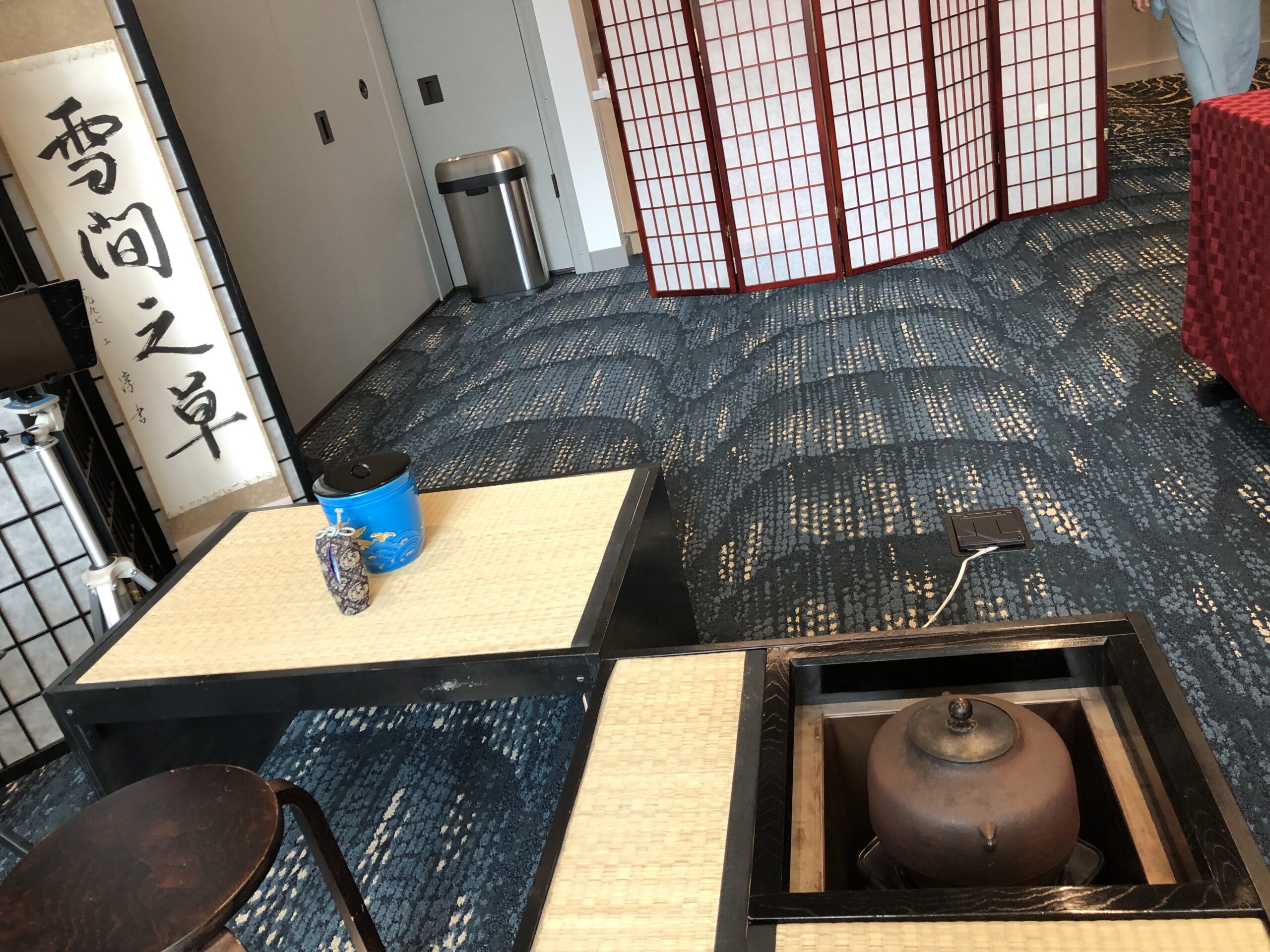
We started in the lobby with osayu and then invited the guests to the tea room where there was a welcome display.The shikishi is by Harada Shodo Roshi, Koro itten no yuki,  a single flake above the hearth.  We were lucky to be joined by international guests via zoom.

The scroll reads Yuki ma no kusa, sprouts under the snow.  Tsubaki and Hellebore in a bamboo vase.

After socializing for a few minutes, we enjoyed a nice bento.

After a short break, koicha and usucha at the temae tables built by Mr. SweetPersimmon.  These tables are easy to transport and set up takes about 5 minutes. Guests appreciated that we were at the tables and not sitting seiza the whole time.

The sweet was nerikiri, plum in the snow.  All the guests had a good time.

A big thank you to Stephanie and Gabi for helping to set up and tear down.

Permanent link to this article: https://issoantea.com/lunar-new-year-for-issoan/

Issoan Hatsugama rescheduled

Issoan Hatugama will not take place on Saturday, due to snow, freezing rain and temperatures in teens predicted for this weekend.  Everyone stay home, stay warm, stay safe.  We will reschedule Hatsugama to February 10, the Lunar New Year.  Hope to see you then.

Permanent link to this article: https://issoantea.com/issoan-hatsugama-rescheduled/

Happy New Year in poetry

Six poets gathered on New Year’s Day 2024 at Issoan to celebrate the New Year.   We shared sake, tea tasting, snacks, matcha, sweets, lunch and incense appreciation  during the day while composing a 28 stanza linked verse.  I hope you like the entire poem.

Earth slowly rises
From winter slumber
In the sunshine
And freshness
On this New Year’s Day 

On this New Year’s Day
Seasons turn with the year
Newborn sun warming winter’s blanket
The pitter-patter of snow drops
Joins into nature’s chorus 

Joining into nature’s chorus
The trees are alive
In the early morning
With the sounds of joy
As the frost recedes 

As the frost recedes
The earth thaws
Ground breaks and cracks
Slowly, rapidly, irregularly
Ready for change 

Ready for change
The dark earth is
Newly revealed
Seeds reaching for the sun
Water nourishing life 

Water nourishing life
Pitter patter
Soaking gently
Into the earth
Wafting scent of spring 

Wafting the scent of spring
Carried tenderly
By the breeze
Our spirits rise
In anticipation

In anticipation
Pale rays bursting
Painting the cerulean sky
Rosy fingers warming
The awakening earth 

The awakening earth
Warmed by the sun
Strengthened by the wind
Nurtured by the rain
Branches filled out to the end 

Branches filled out to the end
Hopeful
For the year ahead
Filled with color
A crown of green 

A crown of green
At ends of branches
Bamboo sprouting
In the forest
A brocade of new life 

A brocade of new life
Winter’s cold
Gives way
A colorful quilt
Drapes across the land 

Draped across the land
Trees laden with buds
And the early blossoms
Of plum and witch hazel
Calling us forth 

Calling us forth
The buzz of activity begins
Tending the flowers
The brocade swelling
With the season’s tempo

With the season’s tempo
Blossoms slowly fade away
Increasing abundance comes
Budding fruit weighs the branches
As time and sun nurtures all

As time and sun nurtures all
Days lengthen
Night fades
Stars meet
As the year’s apex passes 

As the year’s apex passes
Birds dance
Into the twilight
And then sleep in the trees
By the rice fields 

The rice fields
Sway in the breeze
Stretching towards the sun
Gathering vitality
Lazy days 

Lazy days
The wood dragon
Rests in the sun
Ripening with the wheat
Until- 

Until-
Threshing begins
Golden silk
Falling in bunches
Songs echoing through the fields

Songs echoing through the fields
Gleaning birds follow the harvest
Corn stalks stack together
Empty skies darken
The coming autumn approaches 

The coming Autumn approaches
Life slows and prepares for sleep
Ponders what has been
Dreams of what will be
The world slips into night

The world slips into night
We dream of running
Along a silver path
Rising in the sky
Bright light in darkness 

Bright light in the darkness
Points of light sparkle
Infinite space
Cold and crisp
The air snaps 

The air snaps
Sky readies itself
We don extra layers
Quilts and hats
Preparing for skyfall 

Preparing for skyfall
Silence descends
A comforting blanket
As flurries dance and twirl
Behind our retreating backs 

Behind our retreating backs
Weather chases us indoors
With red cheeks and cold toes
Under the kotatsu
We dream of things to come 

We dream of things to come
Hopes and goals
The year returns to the start
Repeating, changing and evolving
Always beautiful

Permanent link to this article: https://issoantea.com/happy-new-year-in-poetry/

Running down to the end of the year

As we approach the solstice it seems like I am running downhill as things accelerate. Holiday plans, travel plans, baking, cooking, wrapping gifts, decorating; it all seems to go faster with less time every year as I get older.

This year I am certainly getting the feeling of growing older and approaching the time when I will no longer be able to do things physically as I once did.  It has also been another year of losing friends, teachers, and colleagues who have passed away.  I have always been the youngest teacher in my area, but a whole generation of sensei in their 80s and 90s are retiring, moving to be closer to family who will take care of them, and yes, passing away.

Facing the fact that I am in the Autumn of my life, I am thinking about what will happen to my tearoom, dogu, kimono, and students when I can no longer teach them.  Making plans for the inevitable is never a pleasant thing to do, but I certainly don’t want to leave my spouse, kids, or grandkids with the dilemma of what to do with all the stuff they have no interest in.

This all leads me to think a little more deeply of the talk Oiemoto did when I was at the Midorikai reunion this summer.  Out of the more than 500 people who have been through Midorikai, how many are still involved in tea? How many are actively bringing new people to tea?  How many are teaching? How many are teaching the next generation of teachers?

As the number of teachers in my Tankokai went from about 16 when I joined, to only 3, I looked behind me and saw no new teachers coming up after me. Who will teach the next generation of teachers when we retire? It takes training a long time to become a teacher, plus discipline, dedication, time and money.  It is a lifetime commitment to this passion.

In the coming year, I am calling on long time students of Chado to look at their practice and think about what will happen when your teacher retires or can no longer teach.  If you have been to Midorikai, or have been studying for 10 years or more, how are you helping train the next generation of teachers?  Are you assisting your teacher in ways that will prepare you to step up when they retire? Are you actively building your keikoba, introducing tea to new people, recruiting new students, and helping your kohai to advance in their studies?

I think it is not enough to just come to keiko every week, do your temae and leave. Sure, it is fun to participate in the intensives, reunions, and anniversary events, but are you helping to plan them, organize them, put on chaji, chakai and demonstrations? Who will put together Hatsugama?   Your teachers do it now, but when they no longer do it, what will happen?

In the coming year, think about ways you can assist your teacher, deepen your own practice of tea, and assist others along the way.  And if you think you might want to teach someday, let your teacher know.  It might be time to step up and begin your training as a next generation teacher.

Permanent link to this article: https://issoantea.com/running-down-to-the-end-of-the-year/

Storied objects

photo credit: Alexandra Hughes

It is exciting to have new students develop a passion for tea.  I have some new students who are so enthusiastic that they have been coming twice a week to keiko.  One of them has a site, Storied Objects, that features artisan handcrafted ware with an aesthetic that appeals to many tea folk.  She is also passionate about telling the stories of the artisans behind the products.  Please go to the site and browse the products.  You might just find something you are looking for.  Christmas is coming!

As part of the backstories to the products on the site, there are interviews with the artists and photos of them in their studios and workshops.  You really get to know the people behind the products and it makes them more meaningful, just as we tell the stories behind the dogu in tea.

The backstory to this student is that she contacted me for Chado lessons in 2020 after I closed the tea room due to Covid.  As I was not taking beginners, I asked if she wanted to put on the mailing list to be contacted when the tea room opened up.  For the next two and a half years, she periodically contacted me to ask if the tea room was going to open and that she was still interested in lessons.  Within an hour of posting the new Introduction to Chado class, she signed up for 10 weeks of lessons.  Then she signed up for another 10 weeks of lessons, and now she is coming twice a week for lessons.

It warms my heart to see her and my other new students hungry for learning about tea.  It is not easy to begin lessons and feel like you will never get the hang of folding fukusa correctly, or not feeling like a cow in the tea room, or which foot do you enter and leave the tea room.  With every new introduction of an aspect of the way of tea, they are eager, humble and willing to learn.  Nothing is beneath them.  They want to clean correctly, and do all the right things in the mizuya.  The student wrote about her experience in the first couple of months of tea lessons here.

Photo credit: Alexandra Hughes

I am almost jealous that they are experiencing  things for the first time.  Making discoveries about how to move their bodies, how to look deeply at dogu, how to express gratitude, all while learning new things about themselves and how they relate to the wider world. The new students attended their first tea gathering at Robiraki last month and it was an event to remember.  Putting it all together for a chaji is inspiring.  It was so inspiring, I recall the first gathering, Robiraki, that I went to almost 40 years ago and how transformative it was for me.

If you have read this far, there is also an interview with me on the site as well.

Permanent link to this article: https://issoantea.com/storied-objects/