Shugyō, transformation through training

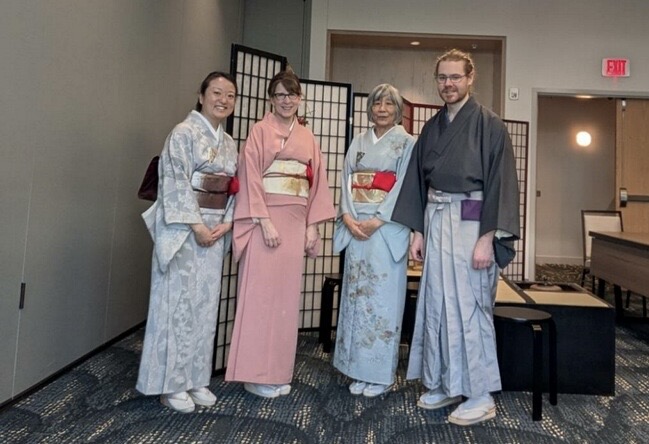
Ten participants gathered at Tahoma One Drop Monastery on Whidbey Island,  Washington for the Zen and Chado summer retreat.  The schedule was rigorous rising early in morning for chanting , zazen and walking meditation.  Meals were vegetarian and were taken in the dining hall using the nested bowls.  Everyone partipcated in kitchen clean up or nitten soji on the grounds.

While there were many insights and awakenings during the retreat, real change begins when we do the work.    It comes down to the  do, gaku, jitsu.  The heart, the head, the hands.  In my view, change begins in the head, with knowledge of oneself and where you have come from.  This is insight and awareness.  But insight alone does not often lead to change.  It is the beginning and shows us where we have work to do.  Behavior has to change.

The hands have to practice the new behavior. Not big behavior change. Start with small changes and do the work consistently.  Like wiping the tatami 6 times a day, not because they are dirty, but building in your body habits that change behavior.  Tea teaches us to do things consistently.  Not once or twice, not for 30 days, but doing it consistently as the new way of doing things.  When these habits become ingrained something shifts and it is the normal thing to do, you become a person who cleans tatami 6 times a day.  This is shugyo, training not for skill acquisition or development, but training for transformation. That is when the change is the do. The heart, the way of being, in your whole heart, body and mind you have now become the change.

The thing is, most people stop after insight. They think that breakthroughs and awareness is the work. Some people use the awareness to articulate more eloquently why they are the way they are and avoid the hard work of behavior change. There is no shortcut to doing the work.  It must be done and done consistently over a long period of time.  Which is why most people don’t do it. They declare that they did the work to face their past.
Insight and awareness is like going to a nutrition class to get healthy, and finding out that processed carbs are bad for you and they are in most of our prepared foods.  But after learning that, going out and buying a pizza, and eating the same foods does not make you any healthier.  Learning to cook so you know exactly what is in the food you eat, becoming vegetarian and eating like a monk is hard work.  It takes discipline and planning.  Okay,  start with no processed foods for one dinner a week.  Consistency is the new way of doing things so that you become a person who eats a healthy dinner one day a week.
“The Institute for Human Psychology approaches insight in this way. Not as an endpoint, but as an entry point. Not as a solution, but as a signal. Insight tells us where work might occur. Capacity determines whether it can. 
This reframing is uncomfortable for many people. It disrupts the idea that understanding oneself deeply should be enough. It challenges the expectation of efficiency in psychological growth. It asks for patience in a culture that rewards clarity and speed.”

This is what tea teaches us. Every week we come to keiko.  We sift the tea every class. we clean before and after every class, we prepare every class, week in and week out. The tasks are the same, until it becomes ingrained into our way of being.   We can apply it to every day life: sitting meditation,  getting in shape, eating healthy, an uncluttered home. All of these things take consistency until they become ingrained into our way of being.

Permanent link to this article: https://issoantea.com/shugyo-transformation-through-training/

Summer and Sweet Peas

It is with a heavy heart and much emotion that we say goodbye to another beloved chajin, Tim Olson sensei, who passed  on June 28.  Summer is the season for sweet peas blooming in the garden with such a sweet fragrance.  They are a favorite flower of both me and Tim sensei.  I painted many of them, especially for him which he framed and hung on the walls of his apartment.

You were a light in my life showing me the way with your quiet presence, sense of humor, and  insightful teaching.  Our longstanding friendship carried me through dark days as well as celebrations. I always anticipated your visits, phone calls, zoom meetings with joy to be in your presence again.

Tim sensei was a warm, knowledgeable, and deeply kind teacher who was beloved by all of his students, and had a profound influence on the way that I teach chado today.  His sincere caring, thoughtfulness, and love of beauty, truly embodied the way of tea.  In our weekly phone calls and zoom meetings, we consulted each other with how to teach the way of tea, commiserated with our troubles,  and shared philosophies of life.

I am deeply grateful for the time I got to spend with you, sensei.  You will be so very missed in my life, yet I take your spirit and gifts you have given me over the years to pass on to my own students so that they can know what it is to live the way of tea.

Tim sensei, may the fragrance of sweet peas be ever on the breeze, as you eat your sweets and drink your tea in your well earned rest.  We love you and will remember the lessons your taught us.

Permanent link to this article: https://issoantea.com/summer-and-sweetpeas/

Zen and Chado Summer Retreat

Shugyō
修行

Cultivating the self through a living process that shows up in the refinement of mind, body & spirit.

When: June 11-14, 2026
Where: Tahoma One Drop Zendo, Whidbey Island, Washington
Cost: $375 (including room and board)

Accommodations include tent camping or simple dormitory. Please bring sleeping bag.  Everyone will participate in preparing meals.  All meals will be vegetarian.

How to get to Tahoma One Drop Zendo

Detailed schedule here

Application deadline April 30. $175 deposit required to hold your place, balance due on site. Pay by PayPal here.

Submit your registration here and let us know if you have food allergies, diet restrictions, or health conditions.

Updates can be found here

If you have questions, contact Margie

Permanent link to this article: https://issoantea.com/zen-and-chado-summer-retreat/

45 Years of Tea Together

炉のぬくみ
ことば少なに
茶を分かつ

Hearth’s gentle warmth—
with few words between us
we share this tea.


On February 22, Barbara Sōsei Walker and I held a chakai at the Portland Japanese Garden commemorating 45 years of tea together. Barbara and I grew up together in tea, and as my tea sister she is just as close to me as family.  I have known Barbara longer than I have been married.


We both started lessons under Minako Sōmi Frady in 1981.  Barbara is my sempai by 3 months.  I went to go study at Midorikai in 1997 and then moved to Seattle and studied under Bonnie Mitchell sensei and Tim Olsen sensei.  I started teaching there. When I returned to Portland, I reunited with Barbara who was teaching in Portland,  and we have been doing tea together at various events, chakai, and koshukai ever since.


We can work in the mizuya without speaking words.  When I am in the tea room and Barbara is in the mizuya, she can read my mind even through the walls. Together we have served tea to 100 people with just the two of us.   We can set up a presentation and mizuya in 10-15 minutes.  Over the last 10 years we have probably done at least 300 presentation of Chanoyu all over the city.


For our 45 years together, we wanted to acknowledge people who have taught us, so the toriawase reflected gifts from many sensei. For example, the osayu cups were from Mrs. Henjyoji, the scroll was brushed by Taikyo Nakamura, the tana was a gift from Gregg Tralle.  The mizusashi from Gary Cadwallader sensei, natsume came to me from Hitomi Tetsu, Omotesenke teacher in LA.   The complete kaiki is listed below.


We both know that we could not have sustained our passion for Chado without the training and help of all of our teachers, sempai and supporters. Okagesama de…


Permanent link to this article: https://issoantea.com/45-years-of-tea-together/

Hatsugama, The New Year at Issoan


On January 11, the students and supporters of Issoan gathered at the Cedar Tree Hotel to celebrate Hatsugama.  A bento, koicha and usucha were served with portable table style.

The traditional New Year kagami mochi was displayed as well as a shikishi and bell denoting the year of the horse.  In keeping with the Chokudai of 明 (mei, bright), the scroll displayed read the “The sun shines on heaven and earth,” with the knotted willow and tsubaki flowers.

Three students received menjo.  Ryan Merrill and Chie Tadaki received Nyumon, Konarai and Chabako licenses.  Stephanie Wilson received Daien no So and Hikitsugi assistant teaching license.

Some beautiful kimekomi dolls were gifted to us made by Rie Nakata’s grandmother.

Thank you and well done to the students who helped put on the event.


Permanent link to this article: https://issoantea.com/hatsugama-the-new-year-at-issoan/